The Building: A Georgian Legacy
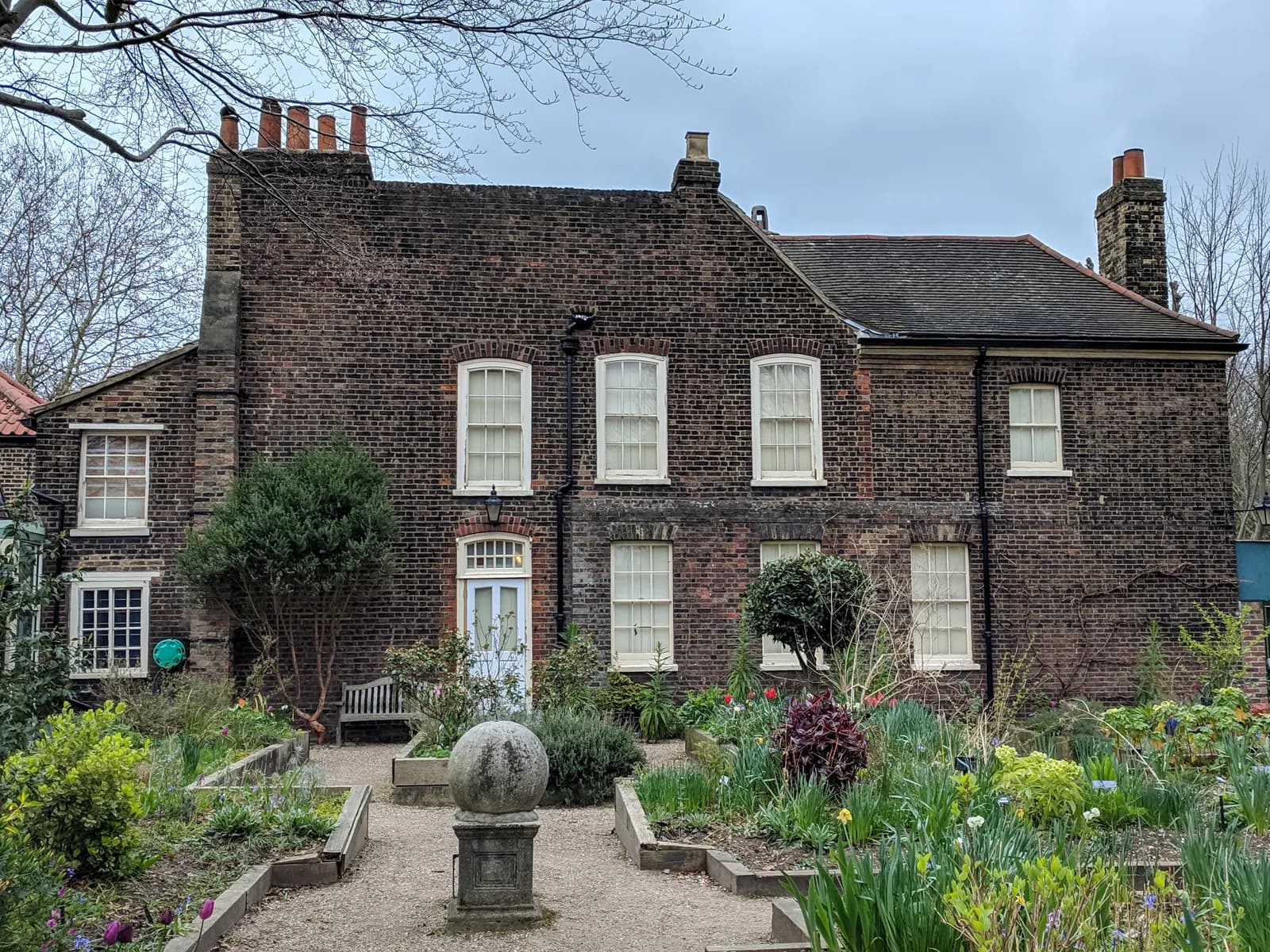
The Water House, now home to the William Morris Gallery, stands on Forest Road in Lloyd Park as one of Walthamstow's most significant architectural treasures. The Grade II* listed building dates to 1744, a date scratched into a brick in the upper east wall, though some records cite 1762 as an alternative construction date. The Georgian mansion features a front porch lined with Corinthian columns and semi-circular bays added approximately 30 to 40 years after its original construction. An ornamental moat that once surrounded the property gave the house its name, though the site itself has an even longer history; a map from 1758 shows the original east and west wings, and records indicate a house dating back to the 15th century once stood on the moated island.
The building's architectural heritage extends beyond its initial construction. The west wing was demolished in the early 1900s, whilst the east wing was replaced during the 2012 redevelopment. The mansion retains its Georgian character whilst having adapted to contemporary museum requirements through sensitive architectural intervention.
Morris and Walthamstow: Formative Years
William Morris was born on 24 March 1834 at Elm House in Walthamstow. His family moved to Woodford Hall when he was six years old, but following his father's death in 1847, the widowed Emma Morris and her nine children relocated to Water House in 1848. Morris lived there from the ages of 14 to 22, a period that would prove formative for the artist, designer, and socialist thinker.
It was within these walls that Morris wrote some of his earliest poetry, sitting at a tall window on the main staircase. His close friend Edward Burne-Jones visited the house and painted studies of the trees on the island. The family enjoyed the ornamental moat for boating and fishing in summer months and ice-skating during winter. One of Morris's brothers, Thomas Rendal Morris, famously 'marooned' himself on the island after reading Robinson Crusoe.
From Private Residence to Public Museum
The Morris family sold Water House to Edward Lloyd, a newspaper proprietor, in 1856. Lloyd's son donated the house and its grounds to Walthamstow in 1900, and Lloyd Park opened to the public in July of that year. The transformation into a gallery dedicated to Morris's life and work took several decades; first plans were drawn in 1914, but it was not until 1950 that the William Morris Gallery officially opened.
The opening ceremony was conducted by Prime Minister Clement Attlee, a fitting choice given Morris's socialist politics. Queen Mary was amongst the first visitors. The gallery was established through significant contributions from Frank Brangwyn and Arthur Mackmurdo, who presented large collections of 19th and early 20th century art in memory of Morris. The timing coincided with Morris & Co having been awarded a Royal Warrant in 1911 for contributions to the coronation of King George V.
The Collection: World's Largest Morris Archive
The William Morris Gallery houses the world's largest collection of William Morris's work, spanning textiles, wallpapers, furniture, ceramics, and printed materials. The nine permanent galleries trace Morris's journey from his early years through his establishment of Morris & Co in 1861, his workshop practices, his retail operations, his printing press endeavours, and his political activism.
Among the collection highlights is Morris's 1862 design for the Trellis Wallpaper, his first wallpaper design. The Woodpecker Tapestry from 1885, designed entirely by Morris and woven at Merton Abbey, represents the pinnacle of his textile work. The gallery also holds the 1896 Kelmscott Press edition of The Works of Geoffrey Chaucer; only 438 copies were produced, with 13 on vellum and 425 on handmade paper. Other significant pieces include the Sussex Armchair from 1869, 'The Lament' by Burne-Jones from 1866, and a Socialist Banner from the 1890s. The gallery also maintains the second largest collection of Frank Brangwyn's work in the United Kingdom, after the British Museum.
Transformation and Renewal: The 2012 Redevelopment
By the late 2000s, the gallery required substantial investment to meet modern museum standards. In 2007, opening hours were reduced due to cost-saving measures by Waltham Forest Borough Council, a move that broke the stipulation of Sir Frank Brangwyn's gift requiring minimum viewing hours. The Heritage Lottery Fund awarded £80,000 in March 2009 for detailed redevelopment proposals, followed by a major grant of £1.523 million in autumn 2010, matched by £1.5 million from London Borough of Waltham Forest.
The building closed for refurbishment in 2011. Architects Pringle Richards Sharratt oversaw the transformation, which included constructing a new wing on the site of the old east wing. The extension added a 60 square metre temporary exhibition gallery, a tea room featuring Morris's 'Thistle' frit pattern windows, and a balcony overlooking the gardens. The top floor was converted into a learning and research centre. The gallery reopened in August 2012, with Grayson Perry's 15-metre Walthamstow Tapestry displayed during the first month. The following year, the gallery won both the Art Fund Museum of the Year award and the Museum and Heritage Show's Best Permanent Exhibition award.
A Living Museum: Community and Future
The William Morris Gallery remains owned and operated by Waltham Forest Council, positioning it as a civic institution rooted in its local community. The surrounding Lloyd Park attracts one million visitors annually and holds a Green Flag Award. The gallery runs a Community Advisory Panel that helps shape its creative programme, and in 2023 launched a Community Residency Programme supporting groups including Stories & Supper, Sustainably Muslim, Waltham Forest Twinning Association, and Waltham Forest Parent Forum.
The gallery continues to maintain Morris's ethos of accessible beauty. Entry remains free, and the institution works with local schools, scout groups, and religious organisations including 31st Walthamstow Scouts, Greenleaf Primary School, PL84U Al-Suffa, and the Sri Karpaga Vinayagar Temple. Current exhibitions include "Women in Print: 150 Years of Liberty Textiles" running until 21 June 2026, with "Earthly Paradise: Radical Living in the UK" scheduled from 3 October 2026 to 28 March 2027. Renewal works are scheduled for summer 2026, ensuring the Grade II* Georgian mansion continues to serve Walthamstow as Britain's premier destination for understanding William Morris's enduring legacy.