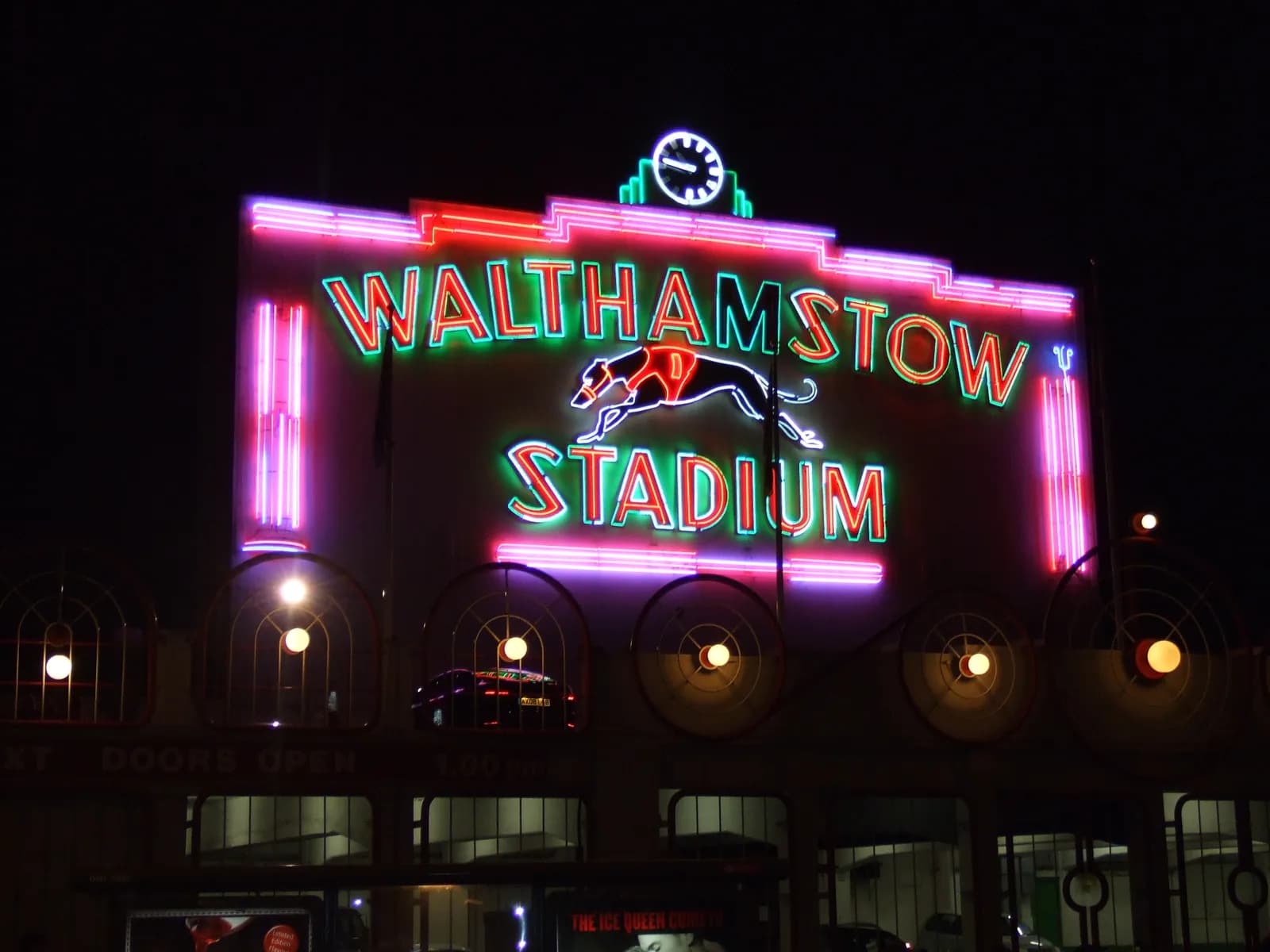
Walthamstow Stadium's iconic Art Deco entrance stands as a rare survivor of London's vanished greyhound racing era. The Grade II-listed facade, nicknamed "Las Vegas at the end of the Victoria line," was preserved by a listing decision that arrived just months before the stadium's closure.
From Chandler's Vision to Grade II Protection
The stadium was the creation of bookmaker William 'Billy' Chandler, who purchased the site for £24,000 in the early 1930s. The Art Deco parapet entrance was constructed in 1932, with the clock tower and totalisator board designed by Thomas & Edge Ltd of Woolwich. The grand official opening took place on Monday 19 June 1933, attended by boxer Jack Kid Berg and aviator Amy Johnson, who presented a trophy as guest of honour.
Between 1931 and 1943, the stadium underwent three major rebuilds as Chandler pursued his vision of the perfect racing venue. His persistence paid off: following the closure of White City in 1984, Walthamstow became regarded as the leading greyhound racing stadium in Britain.
The distinctive pink and green neon-lit frontage was installed in 1951, ahead of the 1952 Coronation. Historic England inspector Claire Brady later described the structure as "an amazing art deco piece... of the finest quality" and "a wonderful piece of construction that is very much valued locally and nationally." On 23 May 2007, the entrance range including the tote board was granted Grade II listed status, with reference number 1391978. The kennels received a separate Grade II listing, reference 1391977.
The Final Race
The stadium's final race took place on Saturday 16 August 2008 at 11pm, with a greyhound named Mountjoy Diamond crossing the finish line as the last winner. Directors had agreed to sell the freehold to a development consortium led by Yoo Capital and K W Linfoot plc, later London and Quadrant (L&Q).
Multiple factors drove the closure: falling profits and attendances, changes to taxation, spiralling running costs, and the extended opening hours of betting shops. More than 450 people lost their jobs. At its peak, the stadium had attracted 50 million visitors per year; by closure, only Wimbledon remained as a greyhound track in London, down from 33 tracks that once operated across the capital.
A Community Races to Save Its Landmark
The "Save the Stow" campaign launched in 2007, led by greyhound owner Graham Goodkind. The campaign gathered more than 3,000 petition signatures protesting the sale. The Walthamstow Stadium Area Residents and Community Association also campaigned for alternative redevelopment plans. Campaigners noted the site's proximity to the 2012 Olympic Stadium as a factor in developer interest.
Despite these efforts, housing plans moved forward. The application was approved on 8 May 2012 by a 4-3 vote, with Mayor Boris Johnson granting final approval on 30 October 2012.
The Grandstand Survives
The Grade II listing proved decisive. While the rest of the stadium buildings were demolished to make way for the "Stadium Place" development comprising approximately 292 new homes, only the entrance facade and kennels survived. The development includes 99 shared ownership properties, along with a nursery, newsagents, and café.
The kennels were retained and converted to sheds for on-site allotments, a nod to the site's working heritage. Historic England remained actively involved in restoration oversight throughout the redevelopment process.
Neon Restoration and Lasting Legacy
In February 2016, a £100,000 restoration of the historic neon sign was completed. The work, carried out by craftsman Andy Cook of Linton Signs on Sewardstone Road, Chingford, involved 320 pieces of glass. The restored facade continues to light up the Chingford Road skyline.
The stadium's cultural footprint extends beyond architecture. The facade appeared on the front cover of Blur's 1994 album "Parklife." It featured in BBC programmes including "New Tricks" and "Just Another Day." Observer writer Laura Thompson called it "the most charismatic greyhound track in Britain."
The site also witnessed significant historical moments. Winston Churchill addressed 20,000 people at the stadium during his 1945 election campaign. The venue hosted speedway racing in 1934 and again from 1949 to 1951, with a team called the Walthamstow Wolves. Stock car racing ran from 1962 to 1968 and again in 1974. Charlie Chan's nightclub operated within the clocktower foundations from 1984 until November 2007.
Two English Greyhound Derby winners raced at the stadium: Signal Spark in 1987 and Slippy Blue in 1990. During the 1930s to 1950s, the stadium notably employed female trainers including Mrs F Deathbridge, Meg Fairbrass, Miss J Griffiths, and Miss B Lark; a practice attributed to Frances Chandler.
What Remains Today
The preserved Art Deco facade now serves as the entrance to the Stadium Place residential development. The restored neon sign continues to illuminate the streetscape, a reminder of an era when 50 million visitors annually passed through those doors. For Walthamstow residents, the Grandstand endures as both architectural heritage and collective memory; a monument to the night-time glamour that once made this corner of east London "the Victoria line's Las Vegas."